Sunday, March 1, 2015

Ohio State Route 772

Even though there are no vestiges of the farm left, in May 2015 I drove down Ohio State Route 772 from Chillicothe towards Waverly.  Why?  Because about fourteen miles south of Chillicothe was where James Madison Hemings had his farm.  So I set out to explore where the farm had been...


I had previously asked a local historian what she knew about the Hemings' home farm.  She knew where the farm was located because her uncle lived in a house on the property when she was a child.  Her uncle had also used another structure which had obviously been a house on that property as a barn. She had milked cows in the "barn".  She remembered standing at the foot of what remained of the stairs wondering how that house could become a barn.  Her uncle used what was left of the second floor to store hay.  It wasn't until she was an adult and did some research on the property that she discovered it had been Madison Hemings' farm.


State Route 772 (SR 772) is a north–south state highway in the south-central portion of Ohio. 

The drive was very scenic, rolling over hills, winding through townships with names I had seen in my US Federal Census research to find where and when my ancestors lived:


Background:

Madison Hemings settled in Pike County Ohio, near the border of Ross County.  Madison earned a living working as a carpenter, hired first by Joseph Sewell to build a house in Waverly, and continued in the carpentry business by building Bizzleport No. 2 and doing joiners work on a store that became known as the Emmitt House Restaurant.

Madison chose as the site for his permanent home, a hill in Huntington Township, in Ross County, where he moved his family in 1849.  In addition to a two-story house, he built a summer kitchen and a barn.  Madison planted an apple orchard on the property.  He and his wife, Mary McCoy, raised their children in that house and it was in this community that they went to school, church and joined in other community activities.  

Madison was known by his neighbors for his honest business dealings.  The Malone family, sold seed corn to Madison and their family oral tradition states that Madison's word was his bond no written receipt was needed when dealing with him.

It was widely accepted that Madison was the son of Thomas Jefferson and considered to bear a resemblance to him.  This was noted on the 1950 US Census.  Some of his neighbors called him Junior President.  

Sunday, February 1, 2015

Staircase to History

Southern Ohio has been historically recognized as a destination of slaves and free people of color as a result of it being on the Underground Railroad path.  That is how my maternal ancestors ended up in the southern counties of Ohio from Virginia.


But southern Ohio was also known to a much lesser degree for its sundown towns.  A sundown town is a town, city, or neighborhood that was intentionally all-white; blacks were not allowed to live there.  Signs were actually posted instructing people of color to leave town before dark.  And if caught, people of color were subject to harassment, threats, or violent acts.

Waverly, the county seat of Pike County Ohio, was a sundown town.  The Works Progress Administration (WPA) guide to Pike county had a footnote about the Waverly’s origins:  The Downings, one of the founding families of Waverly, had written into the agreement that the land he donated to serve as the public square would revert to them if a Negro was ever allowed to live in the town.


My ancestors settled in southern, Ohio, just not in Waverly.  My great-great-great-great-grandfather, born January 19, 1805, was a skillfully trained carpenter from Virginia; he moved to Ohio in 1836.
"When I was fourteen years old I was put to the carpenter trade under the charge of John Hemings, the youngest son of my grandmother." (from the memoirs of Madison Hemings (1873)).  
Madison helped build some of the long-standing structures in Waverly.   The Emmitt House was built in 1861 by the town's first entrepreneur, James Emmitt who hired Madison Hemings to construct a hotel/restaurant along the bank of the newly built Ohio-Erie Canal. 
"We settled in Pebble Township, Pike County.  We lived there four or five years and during my stay in the county I worked at my trade on and off for about four years.  Joseph Sewell was my first employer.  I built for him what is now known as Rizzleport No. 2 in Waverly.  I afterwards worked for George Wolf Senior.  And I did the carpenter work for the brick building now owned by John J. Kellison in which the Pike County Republican is printed.  I worked for and with Micajab Hinson. I found him to be a very clever man. I also reconstructed the building on the corner of Market and Water Streets from a store to a hotel for the late Judge Jacob Row."


When I learned of my 4x great-grandfather's handiwork in 2013, I planned to visit the Emmitt House on my next visit to southern Ohio.  I really wanted that connection to my past...something about my ancestor that I could see and touch.

The Emmitt House started to burn around 9 pm January 6, 1914.  Sadly the heroic efforts of the fire department could not save the old structure. It was destroyed!  We had lost the only tangible link the descendants of Madison had:  the staircase.

When I learned of the destruction caused by the fire, I was devastated that I had not visited the Emmitt House sooner.  I thought I had lost my chance to see my 4x great-grandfather's handiwork.

In September 2014 there was news of the discovery of another staircase built by Madison Hemings; this one at 104 East Emmitt Avenue in Waverly.  It had been known that Madison had reconstructed part of the old Grand Hotel, but that fact had been lost as the building had set empty for a long time.  It had recently been renovated as the Grand Tavern & Restaurant when the staircase was discovered and researched.


In January 2015 I had the opportunity to go to Waverly and visit the Grand Tavern & Restaurant.  But the staircase had been closed off to prevent heat loss from the first floor.  I asked the new owner if there was anyway I could just see and take a photograph of the staircase.  After learning I was a granddaughter of the carpenter who built the staircase he happily reopened the staircase and even let me go up to the second floor to see other wood features constructed by my 4x great-grandfather!!!  And I got my photographs, too.  I am so very grateful for the opportunity. 


Thursday, January 1, 2015

My Fascination with Monticello

Monticello is an historic site that I have visited more than any other.  What draws me back again and again?  

I have memories of my grandmother passing down the oral history to us.  There were quietly-told stories about our famous ancestors:  it was just for us to know and pass on.  

It was when I first read Sally Hemings:  A Novel  that I began taking the stories seriously.  I wanted to know more; I wanted to get the facts; I wanted to confirm my ancestry.  Then I read Thomas Jefferson and Sally Hemings:  An American Controversy and that was when I saw the family tree in the front of the book that I got hooked on pursuing my ancestry.

1993

My very first visit to Monticello was May 7, 1993.  I had never visited as a child.  I only had the oral history of my family's relationship to Monticello and the little I was taught about the site in school.  So I was unsure what to expect and unprepared for how I would feel.  It was a bit overwhelming; so many emotions.  It is very difficult to understand the impact slavery had on my ancestors.  But while taking the house tour there was very little mention of slaves.


1999

Not long after the famous "DNA results" were published in 1998, there was a reunion planned for the Hemings family of Monticello.  I wasn't able to attend the first "family reunion", but my sister did.


2001

May 2001 I returned with my husband and sister for another visit.  The tours had changed: there was more information about how slavery supported the plantation, but it was still not presented as an integral part of life at Monticello.

2012

The Thomas Jefferson Foundation at Monticello collaborated with the Smithsonian Institution’s new National Museum of African American History and Culture (NMMAHC) on an exhibit of "Slavery at Jefferson’s Monticello: Paradox of Liberty" that covered slavery and enslaved people by looking at slavery on Jefferson’s Monticello plantation. The exhibition was on view at the Smithsonian Institution’s National Museum of American History in Washington D.C., from January to October 2012.  My sister, brother and I spent a day studying the displays.  It was so emotional to see our Madison Hemings ancestors featured right there in the Smithsonian!


2013

From February 22 to February 23, 2013, the Thomas Jefferson Foundation at Monticello hosted a unique symposium:  "Telling the History of Slavery: Scholarship, Museum Interpretation, and the Public".  At the Robert H. Smith Center at Montalto, academics and historic interpretures were joined with other symposium participants from the public; I registered my sister and I as soon as the symposium was opened to the public.  The symposium was very educational and accepted the public's input.  (It is great to see some of the input incorporated in the enhanced "Slavery at Monticello Tour" and the enhancements to Mulberry Row.)


I visited Poplar Forest May 2, 2013.  While very similar to Monticello, I found the intimacy and simplicity of the house and grounds more appealing to my taste.


2015

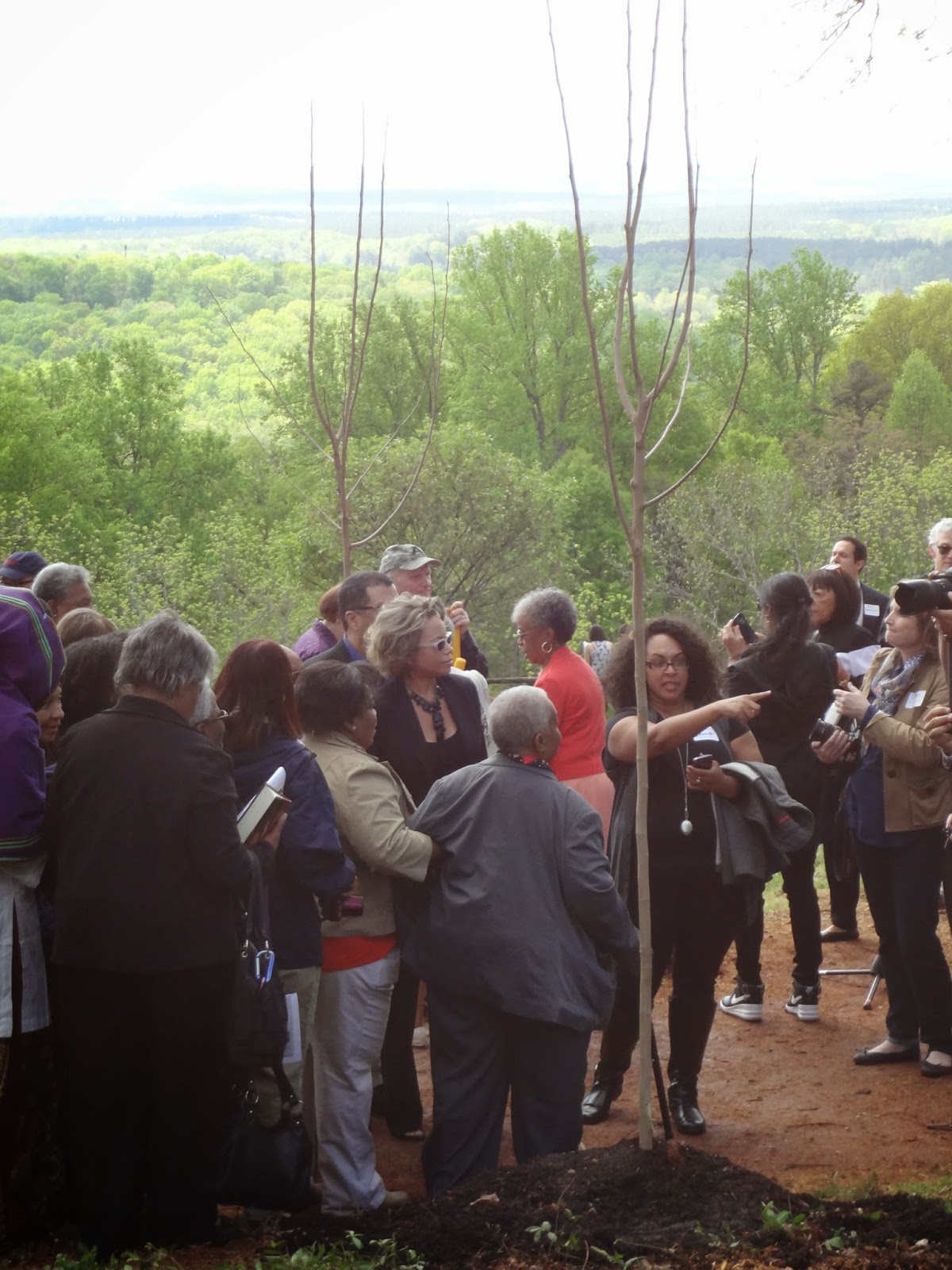
So its been twenty two years since I first visited Monticello.  I returned on May 2nd for the opening of Mulberry Row's enhancements and the reunion of the descendants of the slave families of Monticello.  The program for the day was inspirational.  

There were tree plantings along Mulberry Row and a tour of its new features. The recreated structures, impressive garden, and demonstrations seemed to bring a sense of life back to the row.  (Note:  Mulberry Row was the heart of the agricultural business and the industrial hub of Jefferson's 5000 acre plantation.  As Monticello's main street, it was the center of every-day life for everyone on the plantation.  It was quite busy with twenty dwellings, workshops, and storehouses between 1770 and 1831.)


also had the opportunity to explore the Jefferson Library and the Robert H. Smith International Center for Jefferson Studies, a most impressive place in comparison to some of the other presidential libraries I have visited.  (Note:  The Robert H. Smith International Center for Jefferson Studies is on the Kenwood Campus.  It supports a global network of Jefferson scholars. The advanced-technology center is located at the base of Monticello mountain; it focuses on research and supports other programs at Monticello.)


There was time for reflection at the Jefferson family cemetery and a prayer service at the slave cemetery.

Just as important I had the opportunity during the course of the weekend to meet and spend quality time with some of my cousins in person, some for the first time, during the course of the weekend.  


My key Monticello References:

Brodie, Fawn M.  Thomas Jefferson: An Intimate History.  W. W. Norton & Company, 1974.
Chase-Riboud, Barbara.  Sally Hemings:  A Novel.  Chicago Review Press.  1979.
Gordon-Reed, Annette.  The Hemingses of Monticello:  An American Family.  New York; W. W. Norton & Company, 2008.
Gordon-Reed, Annette. Thomas Jefferson and Sally Hemings:  An American Controversy. Charlottesville; University of Virginia Press, 1997, 1998.
Miller, John Chester.  The Wolf by the Ears:  Thomas Jefferson and Slavery. Charlottesville; University Press of Virginia, 1991. 
Stanton, Lucia.  Slavery at Monticello.  Charlottesville:  Thomas Jefferson Foundation, 1996.
Stanton, Lucia.  Those Who Labor for My Happiness:  Slavery at Thomas Jefferson's Monticello.  Charlottesville, VA; University of Virginia Press, 2012.